Object-first entries
Each treasure gets its own record: story, people, dates, origin, images and intended future. Records interlink as names repeat, so the family map assembles itself from the objects.
Concept demo by Exergist. This domain and brand are available. Learn more
Family legacy & collection discovery
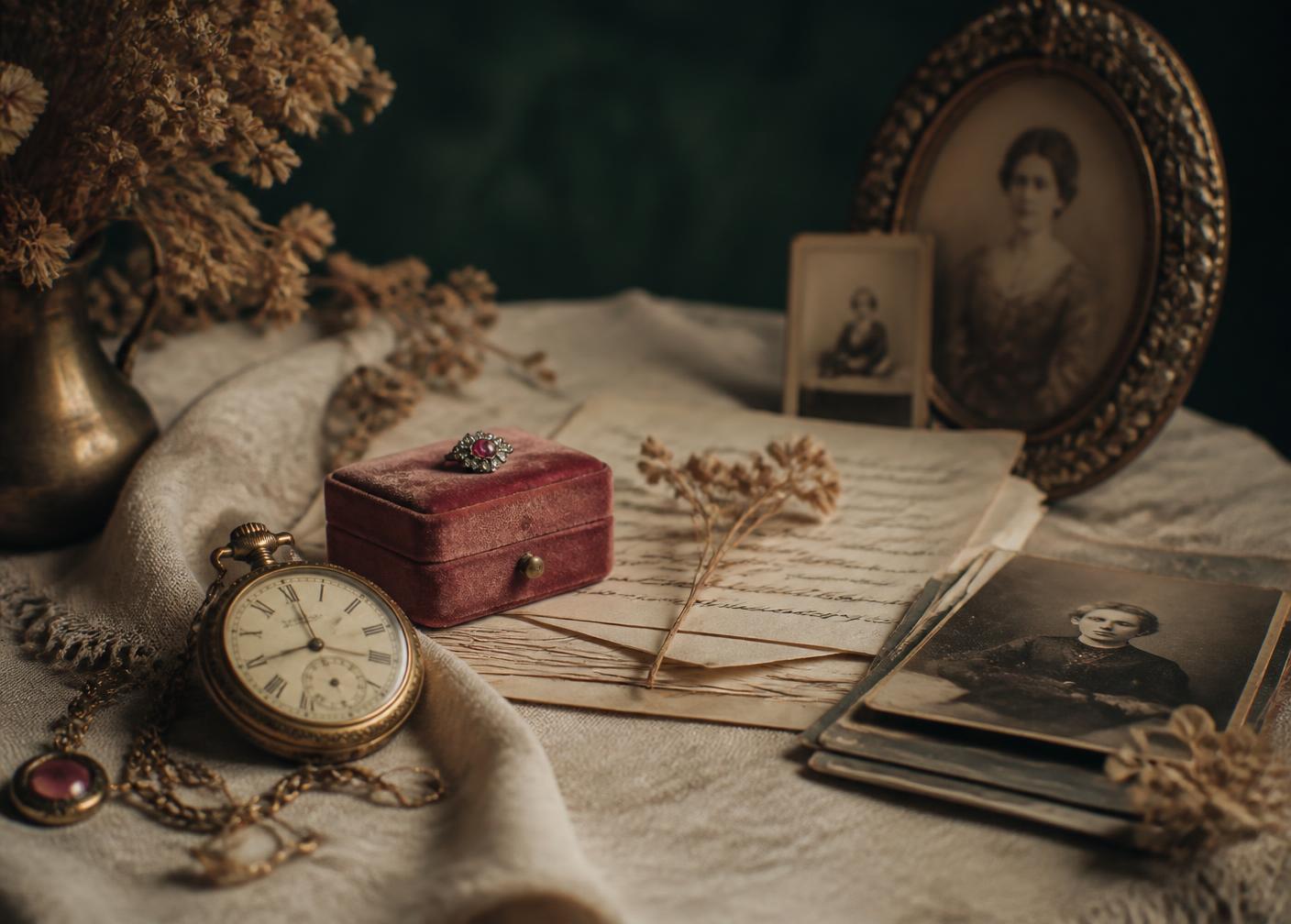
Most of what a family owns outlives the reason it was kept. ElderTreasures records the story, the people, the dates and the wishes attached to each object — so an heirloom arrives in the next generation with its meaning intact rather than as an unexplained item in a box.
Working demonstration below. Nothing you enter is uploaded or published.
The problem
Family knowledge is held in one or two people, usually the oldest, and it is transmitted verbally, in passing, at occasions where nobody is writing anything down. When those people go, the objects remain and the explanation disappears within a single generation.
What follows is familiar: a box of photographs with no names, a ring nobody can place, a piece of furniture kept out of guilt rather than attachment. Items of real value are sold cheaply because their provenance cannot be evidenced. Items of no financial value are kept indefinitely because no one is willing to be the person who discarded them.
Existing tools do not close the gap. Genealogy sites map names and dates but not possessions. Cloud photo libraries store images without context. Wills list assets without reasons. The connective material — who, why, and what should happen next — has no home.
The proposal
ElderTreasures inverts the usual model. Instead of asking a family to document its history in the abstract, it asks about one object at a time — a task short enough to finish in a single sitting and specific enough to prompt genuine recollection.
Each treasure gets its own record: story, people, dates, origin, images and intended future. Records interlink as names repeat, so the family map assembles itself from the objects.
Free recollection is turned into consistent fields — title, narrative, timeline, people, preservation, succession — that remain useful to an executor, an appraiser or a grandchild.
A family archive is not a social network. Records are held privately, shared deliberately with named people, and never published as a public profile.
How it works
Start with the person and the object. Guided prompts collect the date, the origin, the people in the room and the story as the family actually tells it — not as a form would like it told.
The entry becomes a structured treasure record: a title, a readable story, named people, a timeline, and the questions still worth asking while someone can still answer them.
Each record carries preservation guidance matched to the material, plus a recommendation for where to seek a credible appraisal when value needs establishing.
Succession wishes are written down beside the object, with the reasoning intact. Families divide over unexplained gifts far more often than over unfair ones.
This builder runs entirely in your browser using deterministic, rule-based logic and sample archival language drawn from a fictional private archive. No AI service, external API or database is connected to it, and no information you enter is transmitted, stored or published. It demonstrates the shape and quality of the output the full product would produce.
Complete the form, or load the sample entry from the fictional Ellery family archive, and a full treasure record is composed: title, polished story, people, timeline, questions worth asking, preservation notes, succession wishes and an appraisal recommendation.
Applications
The same record structure serves several distinct audiences, each already spending money on part of the problem.
Adult children capturing a parent's or grandparent's account while it can still be given first-hand, one object at a time rather than in a single overwhelming interview.
Collectors of watches, jewellery, ceramics, militaria or books who need provenance and acquisition history held with the item rather than in memory.
Solicitors and executors working alongside letters of wishes, where the sentimental reasoning matters as much as the schedule of assets.
Community archives and small museums accepting donated objects that arrive with thin documentation and a donor who remembers everything.
The point at which most family objects are dispersed. A record made before the move keeps the story even when the object is passed on or sold.
Researchers who have the names and dates already, and need the material evidence — objects, photographs, documents — connected to the tree.
The name
Elder does double duty, and that is the whole trick of the name. It is the person — the grandmother, the great-uncle, the one who remembers — and it is the quality of age itself, the elder version of a thing, the older and prior one. It carries respect without sentimentality and it carries seniority without saying "old". Few English words hold authority and affection at the same time.
Treasures deliberately refuses to specify worth. A treasure can be a diamond or a bus ticket kept for sixty years; the word describes the keeping, not the price. That ambiguity is commercially useful, because the market is not divided between valuable and worthless objects — it is divided between objects someone cares about and objects nobody does.
Together the two words state the proposition in full: the treasures the elders hold, and the treasure that the elders themselves are. A visitor understands the category before reading a line of copy, which is the highest thing a brand name can do.
Not storage, not software — custody. The name implies something is being safeguarded on the family's behalf and handed on deliberately. That promise justifies a subscription, a professional tier and an archival price point in a way that a neutral tech name never could.
Two familiar words, no invented spelling, no dropped vowels, no numeral. Four syllables with an even trochaic rhythm. It survives being said aloud over a telephone, printed on a letterhead, or read once at a family gathering and typed in a week later — the hardest test a consumer domain has to pass.
Consumer legacy subscriptions; estate planning and probate services; auction houses and appraisers; care homes and later-life advisers; genealogy platforms; insurers requiring itemised provenance; and museums and community archives accepting private donations. One name covers all of them without strain.
An exact-match .com of two dictionary words is defensible, direct-navigable and inexpensive to advertise against. It is broad enough to extend into adjacent products — appraisal, insurance documentation, succession planning — yet specific enough that nobody confuses what the business does. Names like this set the ceiling of a brand, and this one sets it high.
Brand opportunity
This site exists to show what the name can support. The domain, the brand identity, this website concept and the associated development package are offered together or separately, for acquisition, licensing, strategic partnership, investment, or further development.
About
This website presents a demonstration business concept developed around a distinctive digital brand. It is part of the Exergist Innovations Catalyst portfolio and is available for acquisition, licensing, strategic partnership, investment, or further development.
Exergist Innovations builds each portfolio brand out past the name: a defined proposition, a coherent identity, and a working demonstration of the product idea. A concept that can be used is assessed far more accurately than a concept that can only be described.
Nothing here is presented as an operating business. There are no customers, no testimonials and no performance figures, because there is no trading history — and inventing any of it would undermine the only thing this site is for.
Enquire
Tell us which route interests you and what you would want to do with the brand. Every enquiry is read by Exergist Innovations directly.
Prefer email? exergist.com/contact